
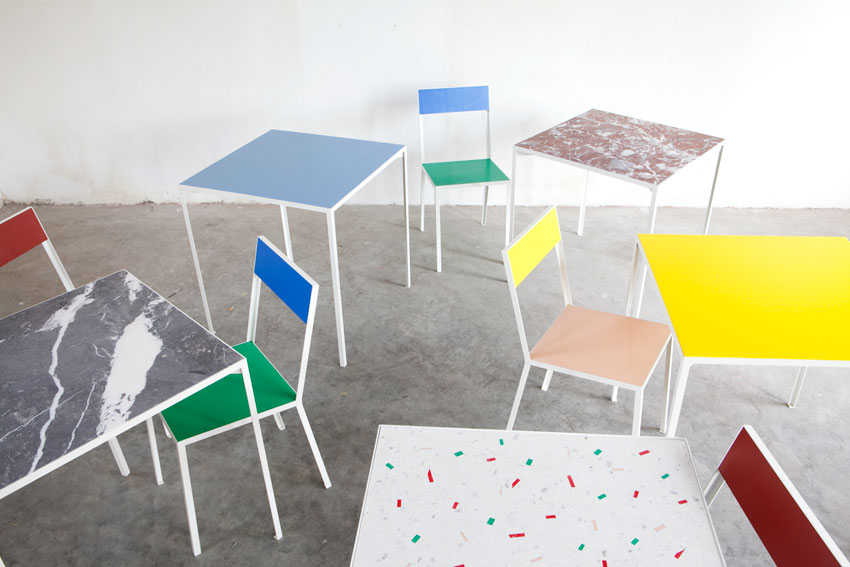
With both Fien Muller and Hannes Van Severen being artists, it’s natural that the collection sits somewhere between design and art – it’s obviously ‘furniture’ but the emphasis is not completely concentrated on function and suggests different ways of living and use of space… an uncanny twist on universal forms. Fien Muller’s photography is suggestive of someone who considers everything in her daily life to be up for participation in the theatre of her compositions – whether choosing her characters from the woodpile, scavenging Hannes’ offcuts or realising the sculptural aspect of a skinned eel, nothing escapes the pot. It seems it’s not so much the qualities of an individual object that are important, but what happens when that object is introduced to another. Her sense of colour is extraordinary in the same way, with quite odd combinations – sometimes subtle, sometimes glaringly opposing, but always with a harmonious result. Fien’s interest in the material is also apparent in her art works, as below with the contrast in texture of the hand chopped wood and the plastic wood effect. It’s not necessary to ask why she has selected these elements to sit together but these incongruous objects are somehow compatible and appropriate. The work of Hannes is often the other way around – with the familiar becoming absurd, in the sense that it loses it’s function and turns irrational. A staircase laid on its side goes nowhere and a closet run through the circular saw loses its balance. The everyday is turned on its head and apparent function negated. The inspiration of their art world is readily seen in the furniture collection with forms reminiscent of Donald Judd or Sol Lewitt but with the humour that comes with collaborations such as that of Fischli & Weiss, who also created from the commonplace and familiar. There is wit in both artists’ work which follows into their furniture collection – two shelving units become entangled and inseperable, two people are forced into conversation by a double seat or the colour range might be dependent on the health and safety colour-coding of a chopping board manufacturer. Its hard to not be reminded of the self-taught, experimental and collaborative Jean Prouvé, who also didn’t work within the constraints of a particular discipline. The feeling you get is of the creators living their lives with the ‘work’ being an equal and necessary aspect of human existence alongside sitting, eating, reading, talking… The Muller Van Severen collection invites participation – the chopping boards and trivets are wall sculptures that adapt to a functional role and change in appearance with use; the double facing seat only achieves its potential with use – two people engaging and perhaps forming new ideas, flirting or just sharing a bit of banter. In this instance, the process of ‘designing’ appears to be more like a conversation and an evolution of ideas, with one finished product inspiring the next – hence the collection working so well as a whole. Working as a duo obviates the individual ego all too prevalent in both the design and art world and allows each object to just exist. The distinction between art and design narrows when the intention of the creators is not to produce one or the other, but to just create and live, and certainly not for the sake of becoming a name to look out for… although, whether through choice or not, this has become the case for both Fien Muller and Hannes Van Severen.
Text: Jonathan Barrie photos and text via Mulle Van Severen
 Read More
 The second issue of OPENHOUSE magazine is out. If you haven’t seen it yet go to the web to find your nearest stockist or buy on-line. In this issue we talk to chef Jerome Waag in San Francisco, and we visit tara Steven’s cooking school in Fez, Labofem a plant shop in a home in Istanbul and Philip Johnson’s Glass House. www.openhouse-magazine.com





 openhouse